My oldest, Bronson, is 16. Over the past twelve months he's brought some really deep things to me. He talks to me about his buddies. He talks to me about girls he likes. He's welcomed me into that part of his life to give him advice, and he really weighs it.
Most 16-year-olds won't. Bronson does because of the trust we've built, and that trust didn't start at 16.
If you're searching for how to build trust with your kids, here's what I've learned raising four of them: Bronson (16), Blake (14), Violet (10) and Wyatt (8).
Trust starts way before the teen years
Connection at a young age drives trust. Trust builds openness when kids hit adolescence and hard things start happening.
When Bronson was born, I jumped in with two feet. Night feedings, rocking, baths, the late-night drives to get him to fall asleep. I owned it. That was the beginning of our connection, and it's bought me so much grace with him since.
Be consistent. Don't go back and forth on your word.
Anything we can do as routine as fathers gives our kids confidence and security in their relationship with their dad. When my kids were little, that meant lying down with them after bath time, reading books and saying prayers with them every night.
With Violet, it was Barbies. We used to play every Saturday and Sunday. It was our ritual. At times I hated it, but I did it anyway, fully present. No phone, no distractions. Just Barbie and Ken and the gang.
As they get older, consistency looks like leadership: not going back and forth on your word.
Care about what they care about
Bronson was very into Legos and dinosaurs. I wasn't really into either one. But I made them important to me because they were important to him.
One of the biggest things we can do as dads is be excited for our kids and invest in the things they are interested in, not the things we want them to be interested in. If you do that, they'll trust you, love you and know without a doubt that you care about the person they are.
Listen without overreacting
Bronson drives now, and some nights he gets home from basketball practice at 10 or 10:30. I'm awake waiting for him. He wants to tell me all about practice.
Usually I'm completely exhausted. My energy bank is empty. But I'll never shut him down. No phone, no hurrying him along. I let him lead, and I ask follow-up questions.
Here's what he's taught me. Don't talk over them. Let them fully say what they're trying to say. Listen, listen, listen. When they're done, be kind and compassionate. They don't have the brain of a 45-year-old.
The trust killer: if we shut them down, talk over them or tell them what they did was idiotic (which sometimes it is), they're less likely to open up next time. Be open to hearing stuff you don't like, and don't overreact in how you respond. That's how they keep trusting that you're focused on leading them, not just fixing them.
Don't force it. Bank it and circle back.
Not every kid is a talker. Blake is my quieter one, with lots of one-word answers. A lot of our conversations happen in the car or on a morning out fishing.
When I get one-word answers, I don't push. I bank it and bring it up again at a different time. You'll never pull it out of them if they're not ready. Meet each kid where they're at.
Lean in when they push back
We don't do sleepovers in our house. When Bronson turned 16, he wanted his best friends, the FAB 4, to spend the night. At first we said no. But the more he asked, the more we leaned in and asked why it was so important to him.
We relented. He had to agree that our family rules don't change and that his friends would have to understand that: what we watch on TV, what time we're inside the house and, the biggest deal of all, phones. At 10 p.m. we took the phones, and we gave them back the next morning.
It's not "my way or the highway" in my house. Hearing them out and keeping the rules steady both build trust.
When you blow it, own it
I don't want you thinking I have this figured out. I can remember disciplining Wyatt, only to find out later he wasn't guilty. Wrongly accusing him, not believing him and punishing him were all withdrawals from his account.
I went to him and said, "Buddy, I really messed this one up. I should have done it differently. Will you forgive me?" Seeing his dad be vulnerable showed him I care about his heart.
Kids can sniff out insincerity easily. It has to be real. (Here's how I apologize to my kids.)
What trust looks like
One night at dinner, something was said to Wyatt and he took it the wrong way. He stormed off to his room, slammed the door and locked it.
I knocked quietly. "Who is it?" "It's dad." Then I heard the door unlock.
That unlock is trust. I lay down next to him, listened, explained what had really been meant and told him three things I love about him. Then he asked, "Dad, can we go play catch?" (The whole story is in how to help an upset child calm down.)
The Connection Account
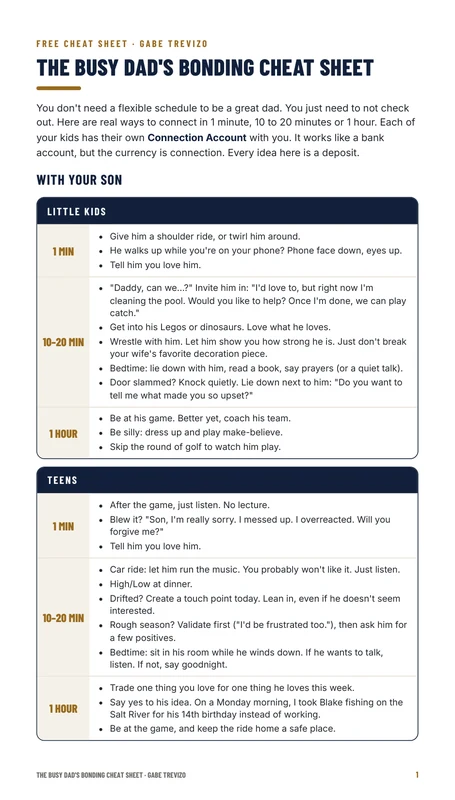
Every kid has a Connection Account with you. It works like a bank account, with deposits and withdrawals, but the currency is connection. The deposits that matter are presence, sacrifice and repair when you blow it.
Trust is what that account adds up to over the years. Discipline without relationship leads to rebellion. Relationship is key.
Start tonight
Pick one kid. Ask about the thing they love most right now, even if you couldn't care less about it. Then listen all the way to the end. Phone down, no lecture.
Free for busy dads: The Busy Dad's Bonding Cheat Sheet. Real ways to connect with your son or daughter in 1 minute, 10 to 20 minutes or 1 hour. Three pages. Grab it and pick one idea for tonight.
Building connection from the little years up is the heart of The Distracted Dad: The Foundation, and the teen years get their own playbook in The Distracted Dad: Guide to Teens. You can find all five Distracted Dad guides at stan.store/gabetrevizo, $24.99 each, or the Complete Collection for $79.99.
Know a dad whose kid has stopped talking to him? Send this to him. It might be the deposit he needs today.
Presence is the best present. — Gabe