My oldest, Bronson, is 16. He talks to me about everything, really. Over the past 12 months, as he's matured, he's brought some really deep things to me. My second son, Blake, just turned 14. Both of them share a bedroom down the hall, and both of them still let me in.
I'm not telling you that to brag. I'm telling you because if you're searching for how to connect with your teenage son, you probably feel the opposite right now. One-word answers. Headphones in. A closed door. I want you to know two things: it's not too late, and it's simpler than you think.
Why connection with your teen starts long before 16
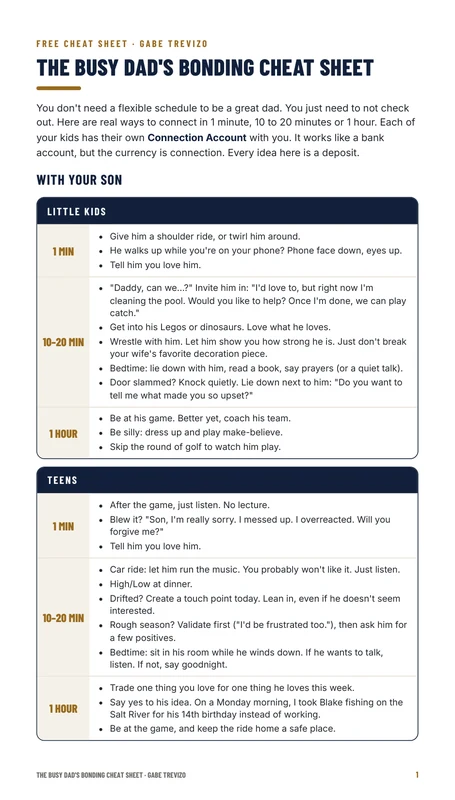
Here's the framework I use with all four of my kids. Every kid has their own Connection Account with you. It works like a bank account, with deposits and withdrawals. But the currency isn't money. The currency is connection.
Connection at a young age drives trust. Trust builds openness when kids hit adolescence and the hard things start happening. When Bronson was born, I jumped in with two feet: night feedings, rocking, baths, late-night drives to get him to fall asleep. As he grew, I showed up at teacher conferences, coached his teams and didn't miss his games. He was into Legos and dinosaurs. I wasn't, but I made it important to me because it was important to him.
What happens between birth and 16? Lots of time. Lots of sacrifice. That's what built the trust he leans on today.
If your son is already a teen: the account is still open. You're not starting from zero. You're starting from today.
Give him an open door at bedtime
When my boys were little, the nightly routine was bath, books, prayers and lying down with them in their bed. At 16 and 14, it looks different.
A lot of nights I'll walk into their room and they're already lying down reading. I sit in the rocking chair. Sometimes a conversation happens, and it turns into a long one. Other times it's quiet for a bit. I can tell there's nothing pressing on their heart, so I say goodnight and leave.
The point isn't to force a talk. The point is to give them the opportunity to come to me, at the same time, in the same chair, night after night. Consistency gives kids security. Teens included.
Let him run the music in the car
This one is easy, and it works. When you're driving, let your teen run the music. You most likely won't like it. That's fine. Just sit and listen.
It gives you insight into his life and his world. And it tells him you're interested in the person he actually is, not the person you want him to be. That's a connection deposit, and it costs you nothing but a few songs.
After the game: listen, don't lecture
Your son already knows he went 0-for-3. He knows about the missed catch. He knows exactly how it feels. In that moment, he doesn't need "maybe you need to work harder." He needs an ear that listens.
There's a time to coach your kids, if you know what you're talking about. But the car ride after the game is never the time.
Blake recently had a tough baseball season. His coach managed a certain way that was frustrating for him. How the coach did it isn't the point. My job was to walk Blake through that frustration. First I validated him: "I can see how that would make you feel this way. I'd be frustrated too." Then I had him tell me a few positives. He said he got to play with his friends, he hit that double into the gap, and his grandma and grandpa came to watch.
Then I told him life is full of moments like that season, and our perspective about it is everything. We can only control what we can control: our energy and our effort. Moments like that are connection deposit overload.
Discipline with relationship, not without it
Teens still need a dad who leads. It really is our job as fathers to discipline our sons, and to do it because we love them. But here's the line I come back to: discipline without relationship leads to rebellion.
Be consistent. Don't go back and forth on your word. Tell him you love him, and show him by your sacrifice. When he knows "dad does these things because he loves me," discipline lands differently. Relationship has bought me so much grace with Bronson.
When you blow it, own it
We are imperfect fathers, all of us. I fail my kids regularly. When I do, I own it, I ask for forgiveness and I mend the relationship.
Teens can sniff out insincerity in a second. A sarcastic or condescending apology does more harm than good. Here's my real script:
"Son, I'm really sorry, I messed up. I overreacted. Will you forgive me?"
Not "I'm sorry, but..." Not "I'm sorry you feel that way." Don't turn it into something about you.There's no better connection deposit than heartfelt humility.
If your son barely talks to you
If you and your teen have drifted, and you're sincere about repairing it, you have to lean in, even when it feels like he isn't interested. It's dad's job to repair. Reach out. Create touch points. Let him know you sincerely care.
He's probably been hurt, and he won't believe you're for real at first. He wants to make sure. Keep showing up. Over time, you'll win him back. And if it's really serious, work with a counselor who can lead the reconciliation.
Start tonight
You don't need a perfect plan. Pick one: sit in his room for ten minutes tonight with your phone in another room. Let him pick the music on the next drive. Say nothing but "I loved watching you play" after the next game. Then do it again tomorrow.
We don't have to be perfect. We have to be present, and we have to lean in.
Presence is the best present. — Gabe