There are six of us at our table. My wife, Cindy, and our four kids: Bronson is 16, Blake is 14, Violet is 10 and Wyatt is 8. Four kids, four ages, four completely different worlds. A 16-year-old and an 8-year-old don't have a lot in common on a Tuesday night.
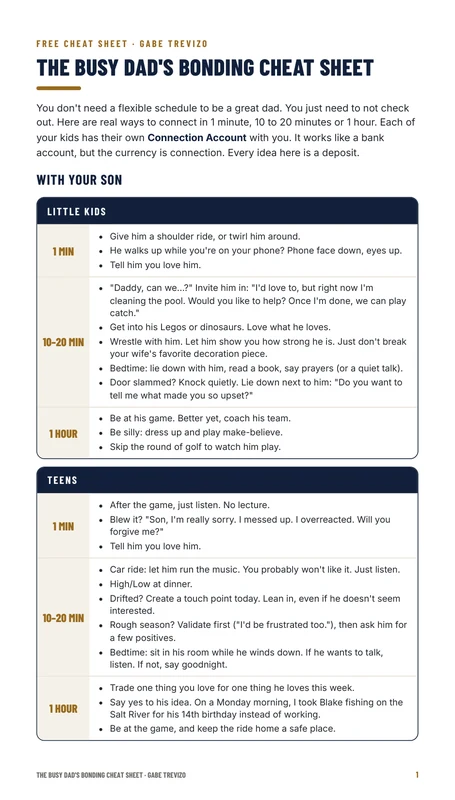
So how do you connect with all of them at once? For us, one of the simplest answers is a habit called High/Low. Everyone goes around and tells their high and their low for the day. Then we discuss it.
That's it. No app, no curriculum, no money. If you're a busy dad looking for family dinner questions that actually get your kids talking, this is the one I'd start with.
What the High/Low dinner ritual is
High/Low is exactly what it sounds like. Each person at the table answers two questions:
- Your high: the best part of your day.
- Your low: the hardest part of your day.
Then, the part most people skip: you talk about it. You don't just collect answers and move on to the mashed potatoes. You ask a follow-up. You listen. You let the table respond.
Most of the connection I write about is one-on-one. Sitting in the rocking chair in my boys' room at bedtime. Bunny coming to life with Violet. A car ride where the kids run the music. Those matter. But High/Low does something different. It's an easy way to connect at a higher level, family-wide. Everybody hears everybody.
Why it works: the Connection Account
Here's the framework I use with all four of my kids. Every kid has their own Connection Account with you. It works like a bank account, with deposits and withdrawals. But the currency isn't money. The currency is connection.
High/Low is a deposit you can make into every account at the same table, in the same ten minutes. Each kid gets heard. Each kid gets a dad who's looking at them instead of a screen. And each kid gets to hear what's going on in their brothers' and sister's lives, and in mom's and dad's.
It's small. That's the point. Connection isn't built in one big moment. It's built in a lot of small, consistent ones. Routines give kids security, and a dinner ritual is one of the easiest routines a busy dad can own.
Presence is the best present. High/Low only works if you're actually there for it. Phone in another room. Eyes up.
How to run High/Low at your table
You don't need rules. But a few simple things help it stick.
- Dad goes first. Model it. Give a real high and a real low. If you only ever share highs, your kids will learn this is a performance, not a conversation.
- Everyone gets a turn. The 8-year-old and the 16-year-old get the same airtime. Mom too.
- Keep it short to start. One high, one low. Nobody needs a speech.
- Then discuss it. Ask one follow-up question. "What happened?" or "How did that feel?" goes a long way.
- Phones away. Including yours. Especially yours. Your kids know exactly what's important to you by where your eyes go.
- Be consistent. It doesn't have to be every single night. But the more it's simply "what we do at dinner," the less it feels forced.
"Alright, High/Low. I'll go first. My high today was... My low today was..."
Then turn to the next person and let them have the floor. No phones, no interrupting, no fixing yet.The low is where the real talk starts
The high is fun. It's easy. Everybody likes sharing the good stuff.
But a lot of the time, the low is where the real conversation is. A friendship that's getting complicated. A tough practice. A teacher, a grade, a coach, a hard moment. That's the stuff that's actually pressing on their heart, and High/Low gives them a natural, low-pressure door to bring it up.
Here's where dads have to be careful. When your kid shares a low, your instinct is to fix it or coach it. Don't lead with that. Lead with listening. I've said it about the car ride after the game, and it's true at the dinner table, too: what your kid needs first is an ear that listens. Validate how they feel. Then, if it's the right time, help them find the perspective.
And sometimes the low is bigger than a dinner table conversation. That's okay. Notice it, and follow up later, one-on-one. The bedtime rocking chair is a great place for that.
Why High/Low works for teens, too
You might be thinking, "My teenager isn't going to play along with this." I get it. Teens can be one-word-answer machines.
But High/Low works for teens because it's not an interrogation. You're not singling them out with "So, how was school?" Everyone answers the same two questions, including dad. Nobody is on the spot more than anybody else.
A few things that help with teens:
- Don't force depth. If the high is "lunch" and the low is "nothing," fine. Take it. Consistency matters more than any single answer.
- Don't lecture off their low. If sharing a low gets them a lecture, they'll stop sharing lows. Listen first.
- Share your own real lows. I don't want my kids thinking I have it all figured out. I don't. When dad is honest about a hard day, it makes it safer for them to be honest about theirs.
- Let the younger kids help. Littler kids usually love High/Low. Their energy can pull the older ones in.
Connection at a young age drives trust, and trust builds openness when kids hit adolescence and the hard things start happening. If your kids are little, start now, and it'll just be normal by the time they're teens. If your kids are already teens, the account is still open. You're not starting from zero. You're starting from tonight.
A dinner ritual for busy dads
I run businesses. I know what it's like to come home with the whole day still buzzing in your pocket. The deal, the email, the text that "just needs a quick reply."
Not every dad has a flexible schedule, and that's okay. But almost every dad has dinner. That's what makes High/Low such a good dinner ritual for busy dads. It doesn't take extra time. It takes time you already have and makes it count.
Great dads don't check out during their free time, no matter how tired they are. High/Low is a simple way to check in instead.
Start tonight
You don't need to announce a new family policy. At dinner tonight, put your phone in another room and say, "Let's do High/Low. I'll go first." Give a real high and a real low. Then let everyone else take a turn, and talk about it.
Do it again tomorrow. That's a deposit into every account at your table, all at once.
Presence is the best present. — Gabe